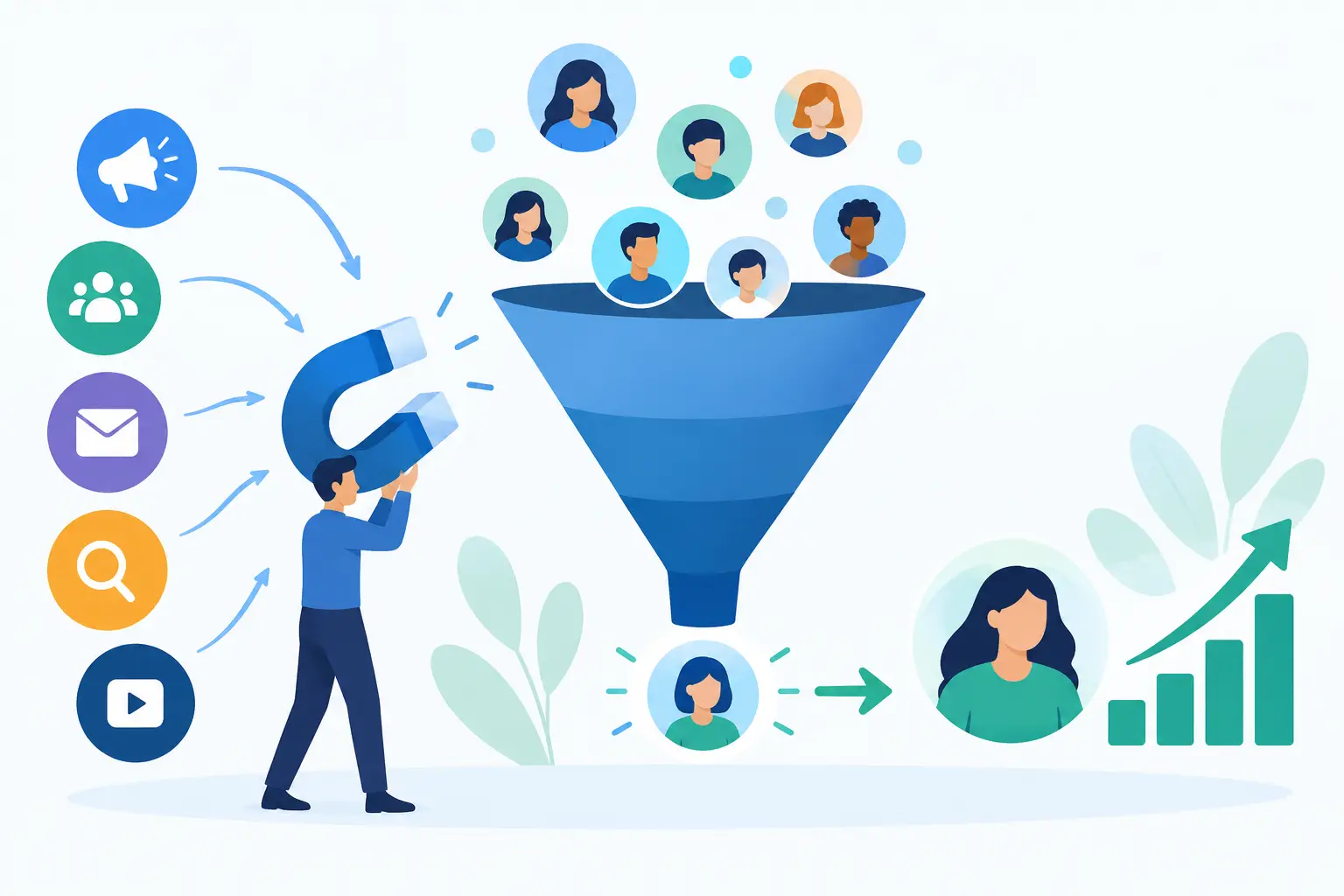
A customer acquisition system is not a single ad campaign, a new website, or a CRM subscription. It is the connected path that takes a potential customer from their first search or phone call to a booked appointment, approved estimate, completed job, and future follow-up. For a busy local business, that connection is often the difference between steady growth and a calendar full of preventable gaps.
If calls go unanswered during service appointments, website inquiries sit in an inbox, and staff copy the same customer details into several tools, the problem is not effort. The problem is that the system is fragmented. Customers feel that fragmentation too. They may never say it directly, but they notice when it takes two days to get a response, when online booking does not match real availability, or when they have to repeat their details at every step.
What a customer acquisition system should do
A practical customer acquisition system makes it easy for the right people to find your business, contact you, get a timely response, and take the next step. Behind the scenes, it should give your team the information and reminders needed to carry that customer forward without chasing notes across text messages, spreadsheets, and inboxes.
For a contractor, that might mean a homeowner finds a service page, submits a quote request with photos, receives confirmation right away, and is routed to a salesperson for follow-up. For a restaurant or entertainment venue, it may mean a customer checks availability, books online, receives a confirmation, and gets a helpful reminder before their visit. For an appointment-based business, it can mean calls, forms, and online bookings all arrive in one organized customer record.
The specific setup depends on your operation. A painter handling large estimates needs a different workflow from a clinic filling appointment slots or a hospitality business managing group reservations. The common requirement is continuity: no lead should disappear because the next action was unclear or dependent on one person remembering to do it.
Start with the customer journey, not the software
Many businesses begin by asking which CRM, booking platform, or advertising channel they should use. Those tools matter, but they are not the starting point. First, map what actually happens when someone tries to become a customer.
Ask a few direct questions. Where do most new inquiries come from? What information does your team need before they can respond? Who owns the next step? How quickly do customers hear back? What happens after an estimate is sent? Where do jobs, invoices, and follow-up tasks live?
This exercise usually reveals the real leaks. A business may be paying for ads successfully, for example, but losing leads because calls are missed after hours. Another may have a polished website that creates inquiries, but no consistent process for contacting people who do not book immediately. A third may be completing good work but never asking satisfied customers for a review or reconnecting with them when the next service season arrives.
A system should be designed around those weak points. Software added without a clear workflow can create another login, another inbox, and another source of confusion.
Make the first response dependable
Speed matters, particularly when customers are comparing several local providers. A person requesting a roof repair, booking a table for a birthday, or searching for emergency home service is unlikely to wait patiently for a reply. They will contact the next business on the list.
That does not mean an owner needs to answer every call personally. It means the business needs a dependable first-response plan. An AI phone receptionist can answer common questions, collect caller details, route urgent calls, and capture after-hours inquiries. Website forms can send an immediate confirmation while creating a lead record and notifying the appropriate team member. Booking tools can show real availability instead of forcing customers to call during business hours.
Automation is useful here because it handles routine actions consistently. It is not a replacement for judgment or personal service. A complex estimate, an upset customer, or a high-value commercial request still needs a knowledgeable person. The goal is to ensure that person receives the context quickly and does not begin the conversation by asking the customer to start over.
Connect marketing to the work that happens next
Marketing is often treated as a separate activity from operations. One vendor runs campaigns, another built the website, and staff manage leads however they can. That arrangement can work for a while, but it makes performance difficult to improve. If you do not know which inquiries became booked work, you cannot tell which marketing is producing valuable customers.
A connected customer acquisition system brings the public-facing and internal sides together. Your website, ads, social media, phone calls, and referral forms should direct inquiries into a shared process. From there, the business can qualify leads, assign ownership, schedule a visit, send an estimate, request approval, and create the next task automatically.
This is also where better branding and photography earn their place. Clear service pages, accurate project images, customer-focused video, and direct calls to action help people decide whether your business fits their needs. They should not simply make the company look polished. They should make it easier for a prospective customer to understand the service, trust the quality of work, and contact you with confidence.
For bilingual markets, the experience should also reflect how customers communicate. A French-speaking caller or website visitor should not encounter a confusing handoff simply because the internal process was built around one language. The right system can support clear bilingual communication while keeping the customer record and workflow organized for your team.
Build the handoffs your team actually needs
The strongest systems reduce ambiguity. When a new request comes in, someone should know whether it is new, qualified, quoted, booked, completed, or ready for follow-up. When a customer calls about an existing job, staff should be able to see the relevant details without searching through old emails.
This does not require turning a small business into a call center. It requires choosing a few meaningful stages and agreeing on what happens at each one. For example, a service business may move leads through inquiry, consultation scheduled, estimate sent, estimate approved, job scheduled, and job completed. Each stage can trigger the right reminder, notification, or customer message.
The trade-off is discipline. A CRM only stays useful if the team uses it. Keep required data limited to what helps people do their work. If staff have to complete a long form after every customer interaction, they will avoid it. If the system automatically captures form submissions, call notes, booking details, and estimate status, adoption is much more realistic.
Measure the gaps, not just the lead count
More leads are not always the answer. If your team cannot respond quickly, deliver estimates on time, or fit qualified work into the schedule, increasing inquiries may only increase stress. A better starting point is to measure the stages where customers are being lost.
Look at response time, contact rate, booking rate, estimate approval rate, no-show rate, and repeat business. These numbers do not need to become a complicated dashboard. Even a simple monthly review can show whether a change is working.
For instance, if many website visitors submit forms but few schedule consultations, the follow-up message or booking process may need work. If estimates are frequently opened but not approved, the proposal may be unclear, too slow to arrive, or missing the proof customers need. If repeat customers only return when they happen to remember you, automated seasonal reminders may create more value than another round of paid advertising.
Choose a system that can grow with the business
A customer acquisition system should be built for the business you run now, with room for the business you want to run next. A simple setup may be right for a small team handling a manageable number of inquiries. As volume grows, you may need routing rules, multiple calendars, sales pipelines, job management connections, reporting, or more advanced phone handling.
The key is not buying every feature at once. It is creating a clear foundation where information moves reliably from first contact through payment and follow-up. NorthPeak approaches this work as a connected business system, matching the website, CRM, automation, booking, and communications tools to the way each local company actually operates.
Your customers should not have to work around your internal processes to do business with you. Give them a clear path to reach you, give your team a clear path to act, and make every good inquiry easier to turn into a real customer relationship.